Buyer Intelligence & Psychology
The Companies Who Know Their Buyers Best, Win.
Most companies operate on assumptions about their buyers. We help you uncover how buyers actually think, hesitate, compare, and decide—so strategy, messaging, sales, and product get sharper.
When You Understand the Buyer Better, the Whole Business Gets Smarter
The payoff of deeper buyer insight reaches far beyond research. It improves decisions across strategy, marketing, sales, and product.
- Sharper Positioning
- Stronger Messaging
- Better Web Conversion
- Smarter Sales Enablement
- More Aligned Product Decisions
- Stronger Competitive Advantage
How We Turn Buyer Understanding Into Action
We do not stop at surface-level personas or isolated research. We build a clearer picture of what buyers are trying to solve, what shapes their decisions, and what moves them to act.
Decision Drivers
See what is really shaping buyer action.
Map the forces behind interest, hesitation, and action.
Uncover the pains, motivations, pressures, and proof that influence movement.
Identify what buyers want, what they fear, what they need to believe, and what makes progress feel safe enough to pursue.
Psychology Mapping
Understand how buyers evaluate and decide.
Go deeper than preferences or surface feedback.
See how buyers compare options, frame risk, and build trust.
Reveal how buyers interpret value, weigh tradeoffs, question claims, and move from curiosity to confidence.
Decision Modeling
Turn insight into something teams can use.
Create a usable model of buyer behavior.
Translate research into a clearer picture of how your buyer thinks and decides.
Organize insight into a practical framework that can guide messaging, web strategy, campaigns, sales conversations, and product decisions.
Buyer Simulation
Pressure-test before the market does.
Explore reactions before execution goes live.
Evaluate messaging, pages, offers, and ideas against buyer perspective before launch.
Use BuyerTwin and simulation to identify friction, expose weak assumptions, and strengthen ideas before buyers ever encounter them.
Ongoing Refinement
Keep buyer understanding current.
Prevent buyer drift over time.
Buyer needs, objections, and expectations change. Your understanding should too.
Refresh insight as markets shift, priorities evolve, and new behaviors emerge so your team stays aligned to real buyer reality.
Leverage AI to operationalize Buyer Insight
Most buyer research gets trapped in decks and forgotten over time.
Our platform BuyerTwin helps keep the buyer’s perspective active—so teams can test, refine, and make better decisions continuously.
- Simulate Buyer Reactions
See how different buyers may respond to messaging, pages, offers, and ideas. - Pressure-Test Decisions
Evaluate whether your strategy actually aligns to what buyers care about. - Keep Insight Alive
Move beyond static personas to a system that evolves with the market.
Most Companies Guess When It Comes To Their Target Audience
Buyer insight built from limited conversations with your best customers will not influence go-to-market decisions that actually drive revenue growth. That's why strategic Buyer Intelligence is necessary.
SURFACE-LEVEL BUYER INSIGHT
What Companies Miss
TRUE BUYER UNDERSTANDING & ALIGNMENT
Internal opinions treated as insight
Companies often rely on stakeholder assumptions, sales anecdotes, scattered feedback, and broad market generalizations to define the buyer.
Insight Source
Real decision drivers uncovered
Real buyer understanding uncovers the motivations, pressures, fears, triggers, and proof requirements that actually shape decisions.
Static personas with little value
Many buyer personas are descriptive but shallow. They summarize who the buyer is without helping teams understand how the buyer thinks, compares, hesitates, and decides.
Buyer Model
Buyer psychology made usable
A stronger buyer model turns psychology into something teams can use — clarifying how buyers interpret value, frame risk, build trust, and move toward action.
Messaging built from the company’s view
Messaging often reflects what the company wants to say, how it describes itself, or what sounds good internally more than what buyers actually need to hear.
Messaging
Messaging shaped around buyer reality
Buyer-informed messaging reflects how the buyer sees the problem, what they care about most, what creates urgency, and what gives them confidence to act.
Research that never changes execution
In many companies, buyer insight lives in a deck, workshop, or strategy document, but does little to shape the actual work that follows.
Execution
Insight applied across the business
Deeper buyer understanding influences execution across positioning, web, content, campaigns, sales enablement, product direction, and customer experience.
Teams interpret the buyer differently
Marketing, sales, product, and leadership often carry their own version of the buyer, which creates inconsistency in messaging, priorities, and decision-making.
Alignment
Teams work from shared buyer understanding
A usable buyer understanding creates alignment across teams so the company operates from a clearer, shared view of what matters to the buyer.
Decisions shaped by assumption
Without strong buyer understanding, growth decisions are often driven by internal preference, urgency, inertia, or the loudest voice in the room.
Decision Quality
Decisions shaped by buyer reality
When buyer understanding is deeper, teams make sharper choices about messaging, offers, experiences, priorities, and where to invest effort.
This Is More Than a Service. It Is a Philosophy.
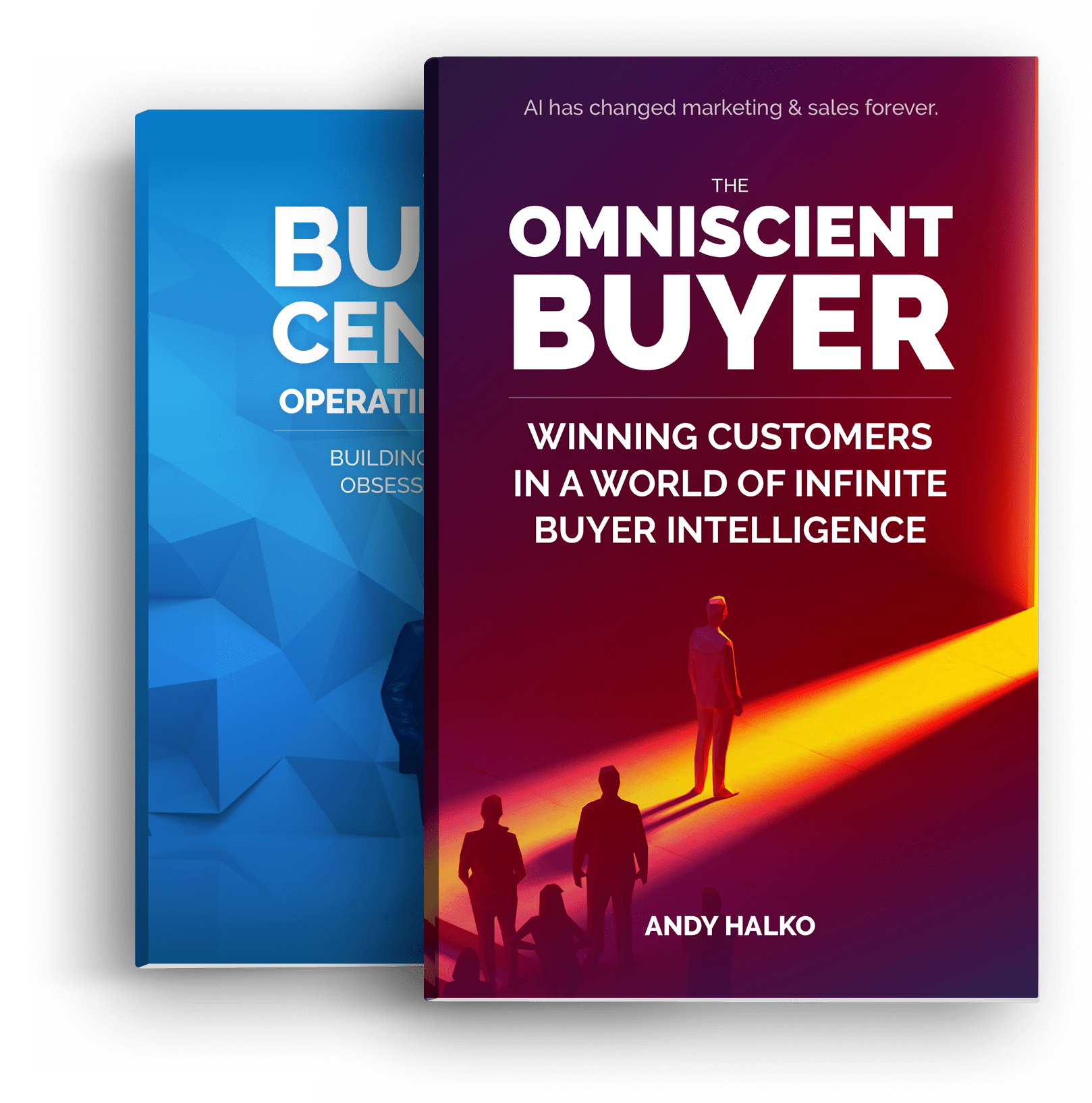
Our founder has written two books on Buyer Intelligence.
The Buyer-Centric Operating System is practical framework for building an organization that consistently sees, decides, and grows from the buyer’s perspective.
The Omniscient Buyer is an exploration of how AI is reshaping buyer behavior, creating a new kind of customer with more information, more leverage, and higher expectations than ever before.


Andy Halko
Founder & CEO
Founder & CEO
I started Insivia in 2002 and for over 22 years I have had the chance to work directly with hundreds of companies and founders to redefine or reinvent their businesses.