AEO Didn’t Kill SEO. It Killed Second Chances.
SEO didn’t die.
What died was the luxury of recovery.
In the search-driven world, buyers gave you room to be unclear. They came back. They searched again. They compared you later.
Answer Engines don’t work that way.
They don’t offer retries. They offer judgment.
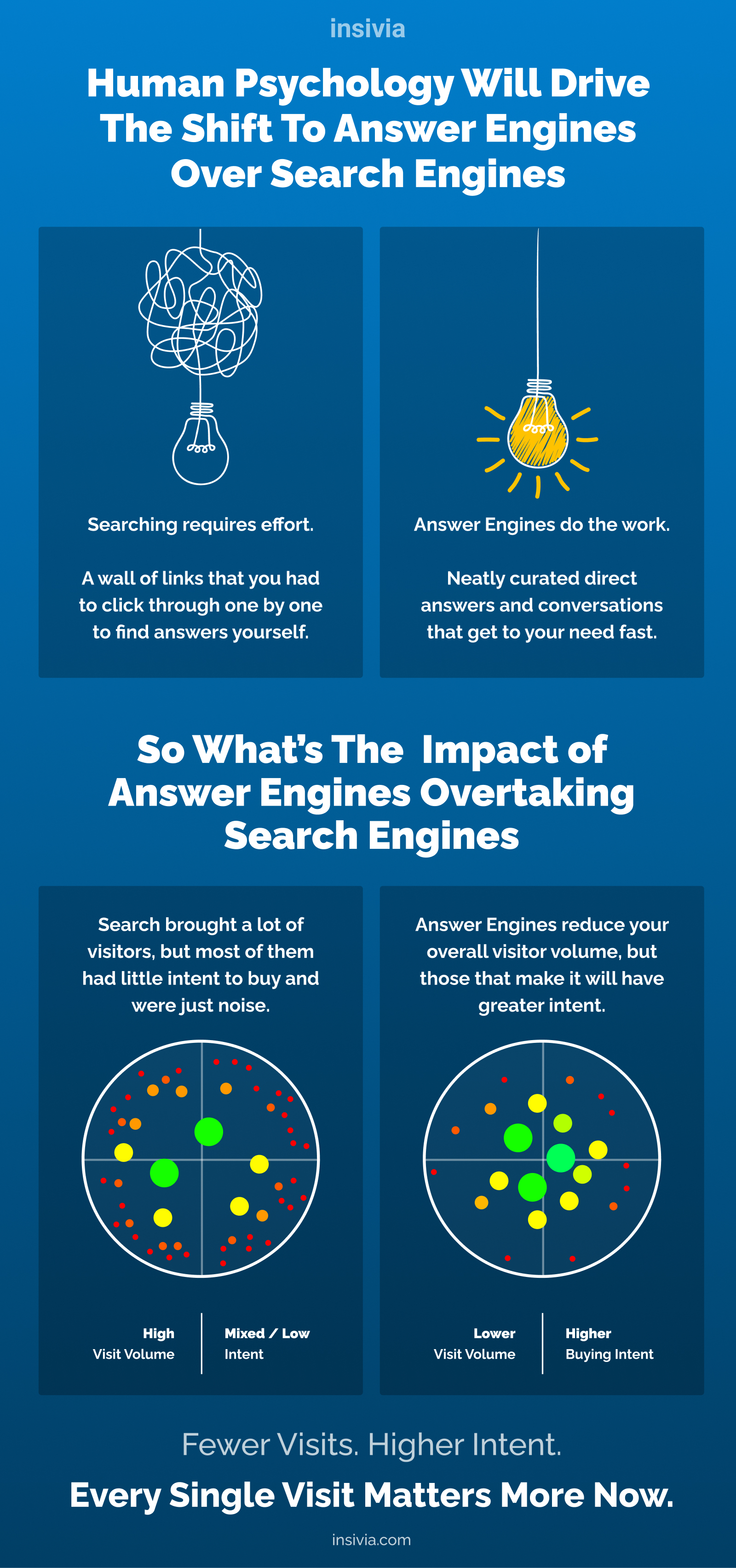
Search Allowed Exploration
Answer Engines Enforce Decisions
Search behavior was forgiving by design.
Buyers could:
- click around
- leave and return
- reframe their question
- revisit options days later
That created second chances.
Answer Engines collapse that behavior.
They present a synthesized recommendation, not a menu. They move buyers from research mode into resolution mode.
Which means the first click carries finality.
Not emotionally. Psychologically.
The Buyer Arrives With a Narrative Already Formed
By the time someone clicks through from an Answer Engine, they are not neutral.
They arrive with:
- expectations
- assumptions
- a mental model shaped by the answer they just read
Your site is no longer setting the frame. It is confirming or breaking it.
If your message:
- contradicts the implied promise
- introduces ambiguity
- feels misaligned with their internal story
The buyer doesn’t debate.
They disengage.
Why “We’ll Explain It Once They’re Here” No Longer Works
This is one of the most dangerous assumptions teams still make.
That the website is where education begins.
In reality, education already happened. Just not on your site.
Answer Engines have already:
- summarized your category
- compared approaches
- framed tradeoffs
- set expectations
Your job is not to start the story.
It’s to continue it seamlessly.
When there’s a disconnect, it feels jarring. And jarring feels risky.
Second Chances Were a Search Artifact
Search behavior created forgiveness:
- low commitment clicks
- casual comparison
- exploratory browsing
Answer Engines remove that cushion.
They create:
- expectation lock-in
- faster elimination
- fewer reconsiderations
When a buyer clicks and something feels off, they don’t think:
“Maybe I’ll come back.”
They think:
“This isn’t it.”
And they move on.
Not to another page. Back to the engine.
This Is Why Friction Is Now Fatal
In the old world, friction slowed conversion.
In the new world, friction ends evaluation.
Because there’s no longer a long arc of discovery. There’s a moment.
A moment where the buyer decides:
- this aligns
- or it doesn’t
No second pass. No redemption round. No gradual warming.
Just alignment—or exit.
AEO Raises the Bar for Relevance, Not Rankings
This shift isn’t about algorithms. It’s about psychology.
Answer Engines amplify one truth:
Buyers don’t want more options. They want fewer doubts.
That means your site must:
- match intent instantly
- reinforce confidence immediately
- remove friction aggressively
Not persuade harder. Not explain longer.
Align faster.
The New Advantage Is Making Sense Immediately
In an Answer Engine world, winning doesn’t mean being found more often.
It means:
- being understood faster
- feeling safer sooner
- confirming belief without effort
Because when second chances disappear, clarity becomes your only margin.
SEO taught us how to attract attention.
AEO demands we respect the moment of judgment.
And the companies that adapt won’t be the ones who fight the change.
They’ll be the ones who understand the real shift:
Answer Engines didn’t kill SEO. They killed hesitation tolerance.
And in that world, frictionless clarity is no longer optional.

Written by: Andy Halko, CEO, Creator of BuyerTwin, and Author of Buyer-Centric Operating System and The Omniscient Buyer
For 22+ years, I’ve driven a single truth into every founder and team I work with: no company grows without an intimate, almost obsessive understanding of its buyer.
My work centers on the psychology behind decisions—what buyers trust, fear, believe, and ignore. I teach organizations to abandon internal bias, step into the buyer’s world, and build everything from that perspective outward.
I write, speak, and build tools like BuyerTwin to help companies hardwire buyer understanding into their daily operations—because the greatest competitive advantage isn’t product, brand, or funding. It’s how deeply you understand the humans you serve.