Search Brought Noise. Answer Engines Bring Signal.
Search gave us traffic. It just didn’t give us clarity. For years, marketers learned to celebrate volume—sessions, clicks, impressions—without asking a harder question: How much of that traffic was actually meaningful?
Answer Engines are exposing the truth. They don’t send more visitors. They send better-filtered ones. And that changes everything about how buying intent shows up on your site.
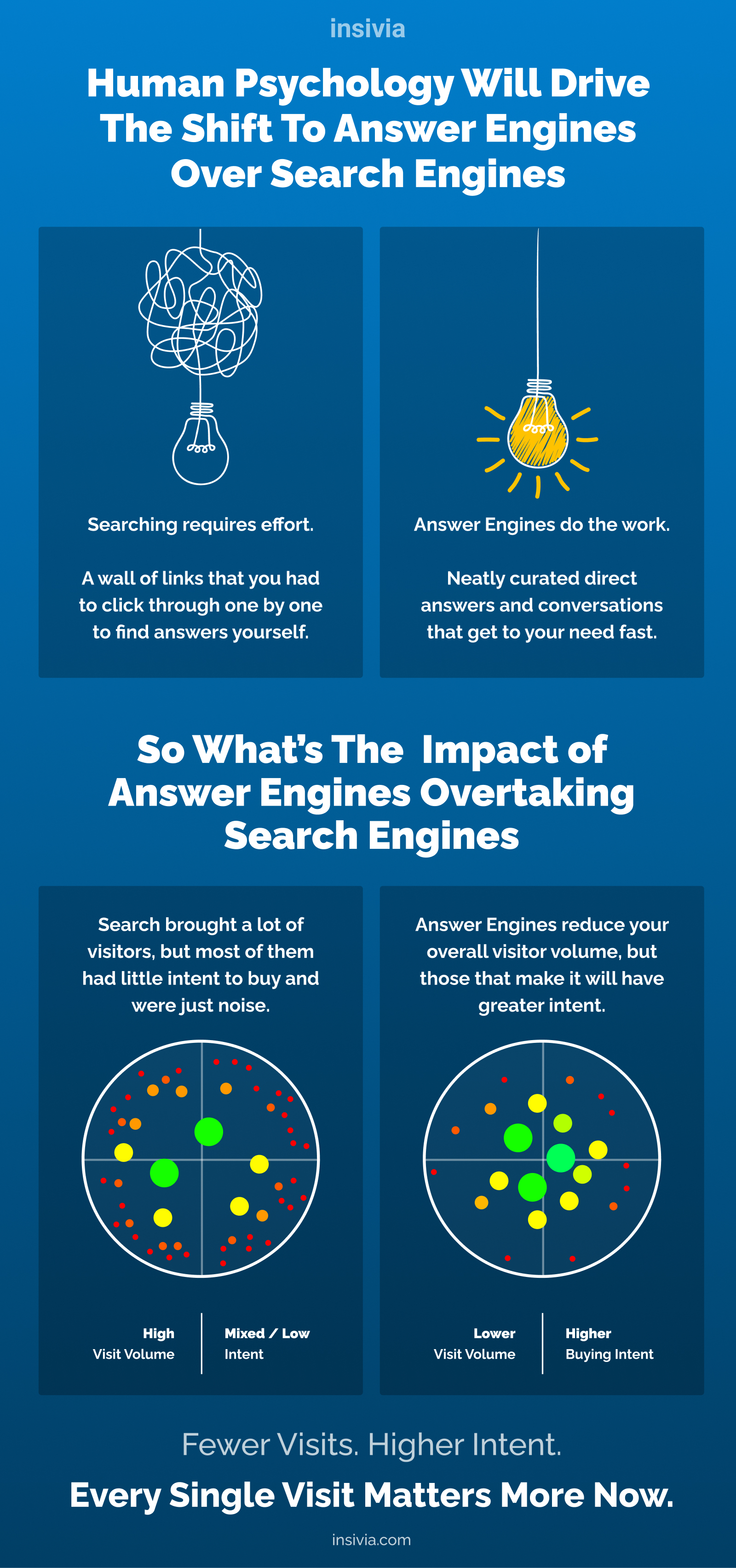
Search Optimized for Curiosity
Search engines are built for possibility. They respond to, broad questions, early curiosity, and loosely formed intent. That’s why search traffic always felt noisy. Because it was. Buyers arrived unsure. They compared casually. They clicked impulsively. They left easily.
On the other hand, Answer Engines Optimize for conviction.
Answer Engines behave differently because they reflect how real buyers think when decisions start forming. They don’t return options. They return judgments. They synthesize relevance, credibility, context, and fit. By the time a buyer clicks through, they are no longer wondering if a solution exists. They are evaluating which one aligns.
Noise vs. Signal Is a Buyer Psychology Shift
Noise feels like activity. Signal feels like intention. Search traffic had a low signal-to-noise ratio many visits, weak intent, and inconsistent motivation.
Answer Engine traffic flips that ratio.
Fewer visitors. Stronger alignment. Clearer purpose.
These buyers aren’t asking: “What’s out there?”
They’re asking: “Is this the right choice for me?”
That’s not a content problem. That’s a decision psychology moment.
Answer Engines Pre-Filter Buyers for You
This is the part most teams underestimate. Answer Engines don’t just route traffic. They screen it. They filter out people who aren’t ready, people who don’t match, and people who would have bounced anyway.
What gets through is a tighter psychological profile higher relevance, higher urgency, and higher expectations. That’s why volume drops – but quality rises. Not because demand disappeared. Because indecision did.
Why This Traffic Is Less Forgiving
Signal behaves differently than noise. Noise tolerates friction. Signal does not. When a buyer arrives from an Answer Engine, they expect immediate clarity, precise positioning, and language that matches their internal narrative.
If your site feels vague, overproduced, or generic, the signal collapses. Not slowly. Instantly. The buyer doesn’t explore more. They disengage. Because in their mind: “If this were truly aligned, I wouldn’t have to work this hard to see it.”
Signal Demands Alignment, Not Persuasion
This is where many websites overcorrect. They try to “sell harder.” But signal-based traffic doesn’t need hype. It needs confirmation.
Confirmation that:
- you understand their situation
- you’ve solved this before
- choosing you reduces risk, not adds to it
Persuasion pushes. Signal validates.
The Real Shift: Fewer Clicks, Clearer Decisions
Answer Engines are not starving your site. They are refining it.
They remove:
- accidental visitors
- low-intent browsing
- false positives
What remains is traffic that carries weight.
Which means:
- every headline matters more
- every claim must earn its place
- every moment of confusion is amplified
Search rewarded attention. Answer Engines reward alignment. And alignment is what converts signal into buyers.
This Isn’t a Traffic Strategy
It’s an Intent Strategy If your goal is still “get more visitors,” you’re optimizing for noise.
The new advantage comes from:
- recognizing signal when it arrives
- designing for late-stage thinking
- removing friction that breaks confidence
Because Answer Engines don’t bring crowds. They bring decisions in progress. And if your site isn’t built to meet that moment, the signal passes straight through.

Written by: Andy Halko, CEO, Creator of BuyerTwin, and Author of Buyer-Centric Operating System and The Omniscient Buyer
For 22+ years, I’ve driven a single truth into every founder and team I work with: no company grows without an intimate, almost obsessive understanding of its buyer.
My work centers on the psychology behind decisions—what buyers trust, fear, believe, and ignore. I teach organizations to abandon internal bias, step into the buyer’s world, and build everything from that perspective outward.
I write, speak, and build tools like BuyerTwin to help companies hardwire buyer understanding into their daily operations—because the greatest competitive advantage isn’t product, brand, or funding. It’s how deeply you understand the humans you serve.