Your Traffic Is Absolutely Going to Drop. Buying Intent Isn’t.
Your website traffic will go down. That part is not a theory. It’s already happening.
But here’s the mistake most teams are making: they’re treating traffic loss as a demand problem, when it’s actually an intent shift.
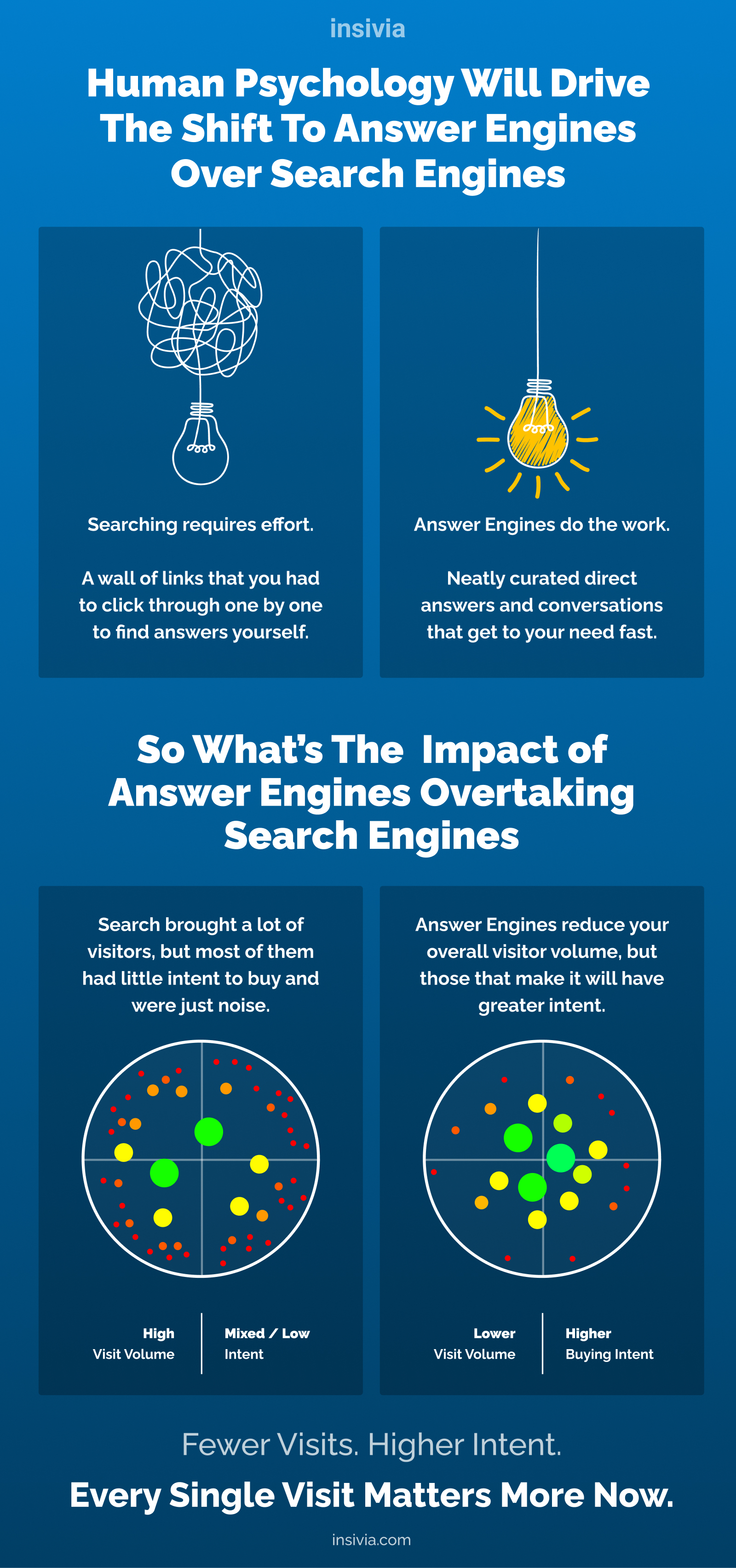
Answer Engines don’t remove buyers from your funnel. They remove unqualified curiosity – people who are just looking without intent.
What’s left is smaller but far more dangerous to mishandle.
Search Was About Exploration
Search engines trained buyers to explore. You typed a query. You scanned ten blue links. You opened tabs. You bounced. You compared loosely. That behavior wasn’t intent-driven. It was option discovery.
Answer Engines are about resolution. Answer Engines behave differently because buyers use them differently.
People don’t go to an Answer Engine asking: “What are all the possibilities?”
They ask: “What’s the best move for me?”
That distinction matters more than any ranking algorithm. By the time a buyer clicks from an Answer Engine to your site, several things have already happened the problem has been framed, categories have been defined, and many alternatives have been silently eliminated.
This is not top-of-funnel traffic. This is decision-in-motion traffic.
Lower Volume Doesn’t Mean Lower Demand
It means intent compression. Search traffic was wide. Answer Engine traffic is compressed.
What used to take five searches, multiple sites, and repeated comparisons now happens before the click. Answer Engines don’t send visitors who are “learning.” They send visitors who are checking.
Checking for clarity, credibility, confirmation, and risk signals. This is why traffic drops but buying intent doesn’t. You didn’t lose buyers. You lost browsers.
The Buyer Is Further Along Than Your Site Assumes
This is where most websites fail. They still treat visitors as if they’re early. They still explain from the beginning. They still “educate.”
But the buyer is already here:
- they know what category they’re in
- they believe a solution is necessary
- they are evaluating you, not the idea
When your site opens with vague positioning, generic value props, or slow narrative buildup, it creates friction immediately. Not confusion. Suspicion. Because psychologically, the buyer thinks: “If this were right for me, it would already feel obvious.”
Answer Engines Change What Trust Feels Like
In search, trust was earned gradually. You had multiple touchpoints. Multiple visits. Multiple chances to recover.
In Answer Engines, trust is borrowed first, then verified.
The engine has already implied relevance. Now the buyer is validating that implication. That means clarity beats cleverness, specificity beats ambition, and proof beats persuasion. Your site is no longer responsible for generating interest. It is responsible for not breaking belief.
Fewer Visits Means Each One Carries More Risk
When traffic was abundant, inefficiency was survivable. Now it isn’t.
Every visit costs more because:
- there are fewer of them
- they arrive later
- they expect alignment instantly
If your site doesn’t immediately:
- orient the buyer
- reflect their problem language
- reduce perceived risk
- reinforce confidence
They don’t “keep exploring.” They go back to the Answer Engine. And you’re not compared. You’re replaced.
This Is Not an SEO Problem
It’s a Buyer Engineering Problem The future isn’t about restoring volume. That era is gone.
It’s about designing sites that:
- assume intent, not curiosity
- remove friction instead of adding story
- clarify fast instead of warming up slow
- convert confidence, not clicks
Traffic will drop. Buying intent won’t.
The companies that win won’t be the ones chasing lost volume. They’ll be the ones who understand what kind of buyer is still arriving – and build for that moment. Because in a world of fewer visits, you don’t get a second chance to make sense.