How Buyers Actually Decide: A Buyer Psychology Series
Most sales strategies fail because they optimize for persuasion instead of buyer psychology.
This series breaks down how buyers actually decide—where deals silently die, why momentum stalls, and what keeps buyers moving forward.
Why This Series Exists
Sales teams are taught to:
- Pitch harder
- Prove more
- Personalize everything
- Overcome objections
Buyers don’t experience sales that way.
They experience:
- Mental effort
- Uncertainty
- Risk
- Confusion
- Pressure
And long before a buyer evaluates features, pricing, or ROI, they make a quieter decision:
“Do I want to keep engaging?”
This series exists to explain what influences that decision.
Not tactics. Not scripts. Buyer psychology.
The Core Idea Behind Every Article
Buyers don’t reject solutions because they’re unconvinced.
They disengage because:
- The experience feels heavy
- The path feels unclear
- The effort feels risky
- The decision feels premature
Each article in this series isolates one specific buyer truth—and explains how it shapes real buying behavior.
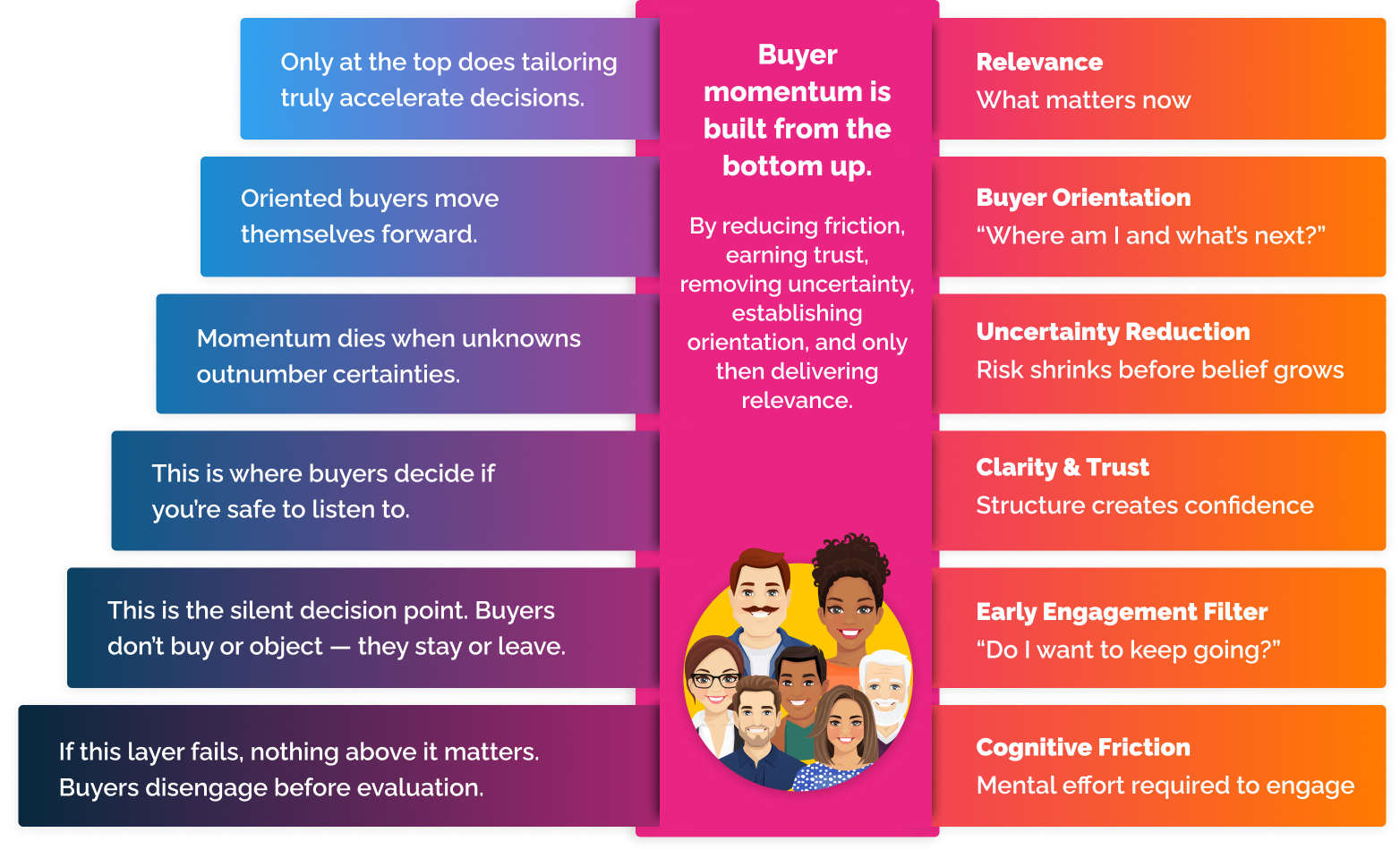
The Buyer Psychology Series
1. Buyers Don’t Reject Solutions. They Reject Cognitive Friction.
Core truth: When engaging with you feels mentally expensive, buyers disengage to protect themselves—often without explanation.
This article introduces the foundational concept: cognitive friction as a risk signal.
→ Read: Buyers Don’t Reject Solutions. They Reject Cognitive Friction.
2. The First Sales Asset Doesn’t Sell. It Decides If the Buyer Stays.
Core truth: Early sales materials aren’t judged on value. They’re judged on effort.
This piece explains why:
- Early assets are filters, not closers
- Selling too early increases drop-off
- Orientation matters more than persuasion at the start
→ Read: The First Sales Asset Doesn’t Sell. It Decides If the Buyer Stays.
3. Clarity Is a Trust Signal, Not a Communication Skill.
Core truth: Buyers trust sellers who make complexity feel manageable—not sellers who sound confident.
This article reframes:
- Clarity as credibility
- Confusion as perceived risk
- Structure as a trust signal
→ Read: Clarity Is a Trust Signal, Not a Communication Skill.
4. Buyers Don’t Need More Proof. They Need Fewer Unknowns.
Core truth: Most deals stall because uncertainty remains—not because evidence is missing.
This piece explains:
- Why proof backfires when buyers are disoriented
- How unresolved unknowns kill momentum
- Why de-risking beats convincing
→ Read: Buyers Don’t Need More Proof. They Need Fewer Unknowns.
5. The Real Job of Sales Design Is to Make the Buyer Feel Oriented.
Core truth: Disoriented buyers don’t object. They disengage.
This article explores:
- Orientation vs persuasion
- Narrative structure in sales
- Why buyers need direction more than conviction
→ Read: The Real Job of Sales Design Is to Make the Buyer Feel Oriented.
6. Personalization Doesn’t Close Deals. Relevance Does.
Core truth: Buyers don’t respond to customization. They respond to what matters right now.
This final piece reframes:
- Personalization as a baseline expectation
- Relevance as a decision accelerator
- Timing as more important than tailoring
→ Read: Personalization Doesn’t Close Deals. Relevance Does.
How to Read This Series
You can read these articles in any order.
But if you want the full picture:
- Start with cognitive friction
- Move into early-stage decision filters
- Understand clarity and trust
- Learn why proof fails too early
- See how orientation sustains momentum
- End with relevance over personalization
Together, they form a single idea:
Buyers don’t need better sales tactics. They need sales experiences designed around how they think.
Why This Matters
Whether you’re designing:
- Sales materials
- Websites
- Demos
- Proposals
- Go-to-market strategies
You’re not just communicating value.
You’re shaping how safe it feels to proceed.
And safety—not persuasion—is what keeps buyers moving.

Written by: Tony Zayas, Chief Revenue Officer
In my role as Chief Revenue Officer at Insivia, I help SaaS and technology companies break through growth ceilings by aligning their marketing, sales, and positioning around one central truth: buyers drive everything.
I lead our go-to-market strategy and revenue operations, working with founders and teams to sharpen their message, accelerate demand, and remove friction across the entire buyer journey.
With years of experience collaborating with fast-growth companies, I focus on turning deep buyer understanding into predictable, scalable revenue—because real growth happens when every motion reflects what the buyer actually needs, expects, and believes.