Buyer Intent Signals in EdTech
This article is part of our series on:
EdTech Buyer Psychology & Decision-Making in our EdTech Knowledge Hub
Intent is a psychological state – not a marketing event
Most EdTech teams think intent shows up when a buyer raises their hand.
A demo request. A contact form. An RFP.
By the time those signals appear, the decision is already constrained.
In education markets, intent forms quietly—internally—long before vendors are involved.
This pillar establishes a critical truth:
EdTech buyers don’t signal intent through activity.
They signal it through behavior, silence, and internal sense-making.
If you wait for obvious signals, you’re reacting too late.
The Intent System Education Buyers Operate Within
Education buyers don’t wake up one day “ready to buy.”
They move through psychological states that look invisible from the outside:
- Curiosity without urgency
- Concern without clarity
- Interest mixed with anxiety
- Readiness masked as caution
Intent is not binary. It’s progressive—and fragile.
How Intent Actually Develops in EdTech
Intent emerges when three internal conditions begin to align:
1. Acknowledged Pain
EdTech buyers feel something is unsustainable:
- A process is breaking
- A metric is under scrutiny
- External pressure is increasing
While acknowledging risk doesn’t mean acting yet, it is the seed of intent.
2. Internal Sense-Making
Buyers gather information to:
- Understand options
- Test narratives
- Anticipate objections
This phase is quiet by design. Now that seed of intent begins to take root.
3. Defensibility Readiness
Only when EdTech buyers believe they do the following does intent start to actually blossom.
- Explain the problem
- Defend the solution
- Survive the decision
Most EdTech teams want to focus on the first stage and obsess over their buyer’s pain.
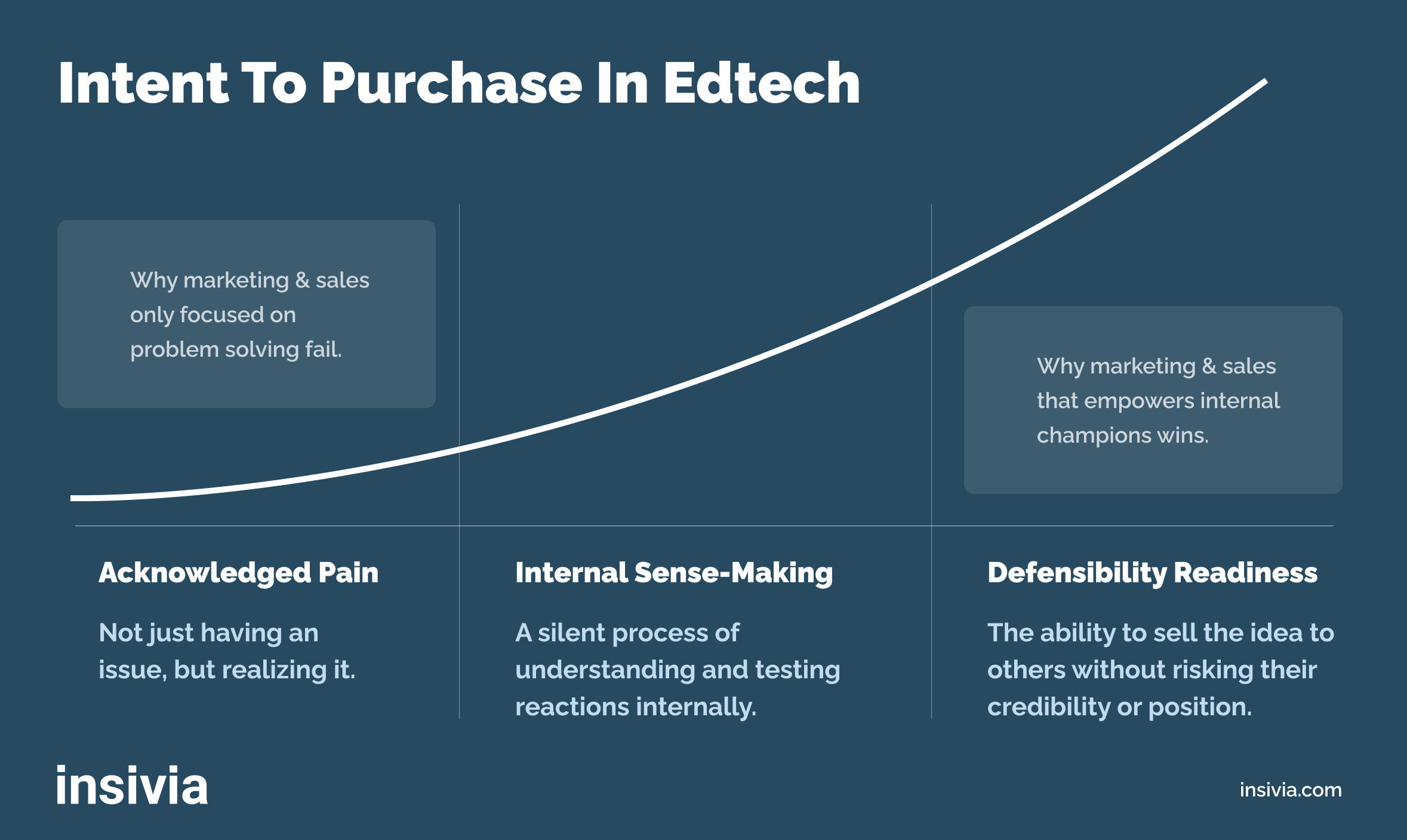
Often sense-making and defensibility aren’t natural for them, so they don’t even realize they exist.
Why Traditional Intent Signals Fail in Education Markets
EdTech teams often misinterpret:
- Silence as disinterest
- Research as curiosity
- Engagement as readiness
In reality:
- Silence often means internal work is happening
- Research often means their need to reduce anxiety
- Engagement often means the start of justification building
Intent in EdTech is less about want and more about preparedness.
This is worth repeating – EdTech intent to buy grows with being prepared, not want. Read it again.
Until buyers feel safe moving forward, visible intent remains suppressed.
How We Break Down Buyer Intent Signals in EdTech
The following articles dissect the hidden mechanics of intent – where it forms, how it evolves, and why it’s often misunderstood.
Why EdTech Buyers Research Quietly for Months
Education buyers don’t research quietly because they lack urgency.
They do it because exposure is risky.
This article explores:
- Why early engagement feels unsafe
- How buyers build private conviction before public conversation
- Why most vendor outreach arrives mid-thought—not at the start
If your pipeline feels slow, this is likely where momentum is actually forming.
How EdTech Buyers Self-Educate Before Engaging Vendors
Before buyers talk to you, they’re preparing to talk about you.
They study:
- Peer examples
- Independent validation
- Institutional language they can reuse internally
This article explains:
- How buyers construct internal narratives
- Why vendor content is used as evidence, not inspiration
- What self-education signals look like before contact is made
Your content isn’t just marketing—it’s ammunition.
The Difference Between Curiosity and Readiness in EdTech
Most EdTech teams treat interest as intent.
That’s a mistake.
Curiosity is low-risk exploration. Readiness is high-risk commitment.
This article breaks down:
- Why curiosity feels active but leads nowhere
- What changes psychologically when readiness emerges
- How misreading this difference kills trust and timing
Understanding this distinction is the difference between nurturing and nagging.
What EdTech Teams Must Relearn About Intent
Once you understand how intent really forms, several assumptions collapse:
- Not all engagement is forward momentum
- Not all silence is lost opportunity
- Not all readiness looks confident
Intent is often quiet, cautious, and internal.
Your job is not to force visibility.
Your job is to recognize it when it’s forming.
FAQ: Buyer Intent Signals in EdTech
Why do EdTech buyers research for so long without reaching out?
Because reaching out creates exposure.
Once a buyer engages a vendor:
- Opinions form
- Conversations spread
- Risk increases
Private research allows buyers to think safely.
How can we tell if quiet research is real intent or just curiosity?
Curiosity seeks information. Intent seeks defensibility.
Signals of intent include:
- Repeated validation behaviors
- Focus on proof and precedent
- Internal alignment questions
Curiosity asks “What is this?” Intent asks “Can we justify this?”
Are demo requests reliable intent signals in EdTech?
They’re late-stage indicators—not early ones.
By the time a demo is requested:
- Internal framing has already happened
- Decision constraints are set
- Risk tolerance is narrowing
Demos confirm direction more than they create it.
Why do buyers engage heavily, then suddenly stall?
Because engagement often precedes risk realization.
As decisions approach:
- Anxiety increases
- Internal objections surface
- Momentum pauses while alignment catches up
Stalling often means thinking—not rejection.
Is this behavior different in K–12 vs Higher Ed?
The psychology is consistent. The triggers differ.
- K–12 intent is often driven by compliance, equity, or public pressure
- Higher Ed intent is often driven by accreditation, enrollment, or internal politics
In both cases, intent forms before visibility.
How should marketing and sales respond to invisible intent?
By shifting focus from capture to support.
Effective teams:
- Provide defensible proof early
- Avoid premature urgency
- Help buyers think, not decide
Pressure before readiness increases resistance.
What happens when teams misread intent?
They:
- Chase curiosity
- Push timing too early
- Burn trust with anxious buyers
Most “low-intent leads” aren’t low-intent. They’re early-stage and unprotected.
The Core Takeaway
If you only recognize intent when buyers speak up, you will always arrive late.
EdTech intent forms quietly, cautiously, and internally—long before vendors are invited in.
This pillar teaches you how to see it forming, before it becomes visible, verbal, or actionable.

Written by: Tony Zayas, Chief Revenue Officer
In my role as Chief Revenue Officer at Insivia, I help SaaS and technology companies break through growth ceilings by aligning their marketing, sales, and positioning around one central truth: buyers drive everything.
I lead our go-to-market strategy and revenue operations, working with founders and teams to sharpen their message, accelerate demand, and remove friction across the entire buyer journey.
With years of experience collaborating with fast-growth companies, I focus on turning deep buyer understanding into predictable, scalable revenue—because real growth happens when every motion reflects what the buyer actually needs, expects, and believes.