7 Key Marketing Strategies for Technology Companies
Technology companies love talking about innovation.
AI-powered this.
Predictive that.
If you’re in SaaS, EdTech, LegalTech, HRTech, FinTech, PropTech, insert-your-favorite-tech-here… you’ve probably launched something “revolutionary” at least twice this year.
But here’s the uncomfortable truth we don’t put in pitch decks:
Buyers don’t care about your innovation.
They care about their problems.
And those buyers – especially in 2026 – behave nothing like they did even three years ago.
They research anonymously.
They avoid sales until the last possible moment.
They trust peers more than brands.
They consult AI answers before Google.
And when they finally land on your site?
They’re expecting clarity, credibility, and a buying experience that doesn’t feel like a maze built by a committee.
The companies winning today aren’t the ones shouting the loudest.
They’re the ones building marketing systems that orbit around one thing:
The buyer’s worldview.
If you understand how your buyers think, what they want, what they fear, and how they make decisions, you can grow faster with half the effort.
This article breaks down seven buyer-centric strategies used by modern software and technology companies to drive demand, differentiate in crowded markets, and create customer experiences that actually make people say, “Finally, someone gets it.”
Let’s get into it.
Build a Buyer-Centric Foundation: Positioning, Messaging & Deep Audience Understanding
After working with hundreds of tech companies, I can tell you this: most think they understand their buyers — but very few actually do.
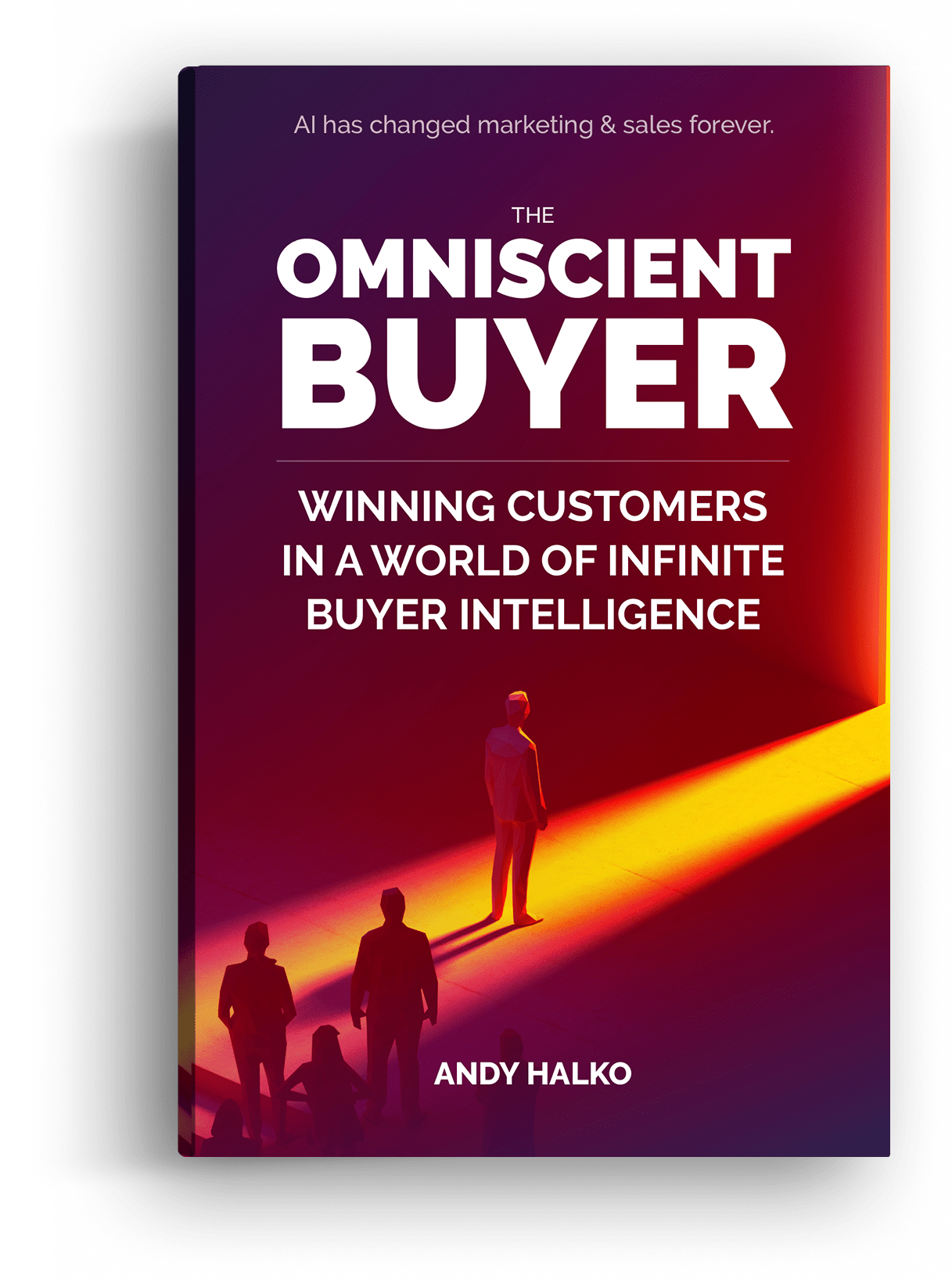
I actually wrote a whole book about how companies can become buyer-centric.
They have an ICP slide.
A persona deck last updated when the Marvel Universe was small, fresh and exciting.
The amount of times I’ve worked on a brand strategy built around one salesperson’s ‘gut feeling’ kills me.
That can’t work anymore.
Your buyers are changing constantly.
Their pains are evolving.
Their internal politics shift.
Their expectations are shaped by every tool they use, not just yours.
And thanks to AI answers and zero-click journeys, they show up more educated (and more skeptical) than ever.
A modern marketing strategy doesn’t start with tactics.
It starts with understanding, a deep, uncomfortably honest understanding, of the humans you’re trying to influence.
Why Buyer Understanding Is Your New Moat
Differentiation is a daily battle.
Everyone says they’re “innovative,” “intuitive,” and “AI-driven.”
Those words don’t mean anything anymore.
Buyers are blind to them.
But do you know what still carries weight?
Having a sharper, more empathetic understanding of your buyer than anyone else.
Not just their demographics.
Not just their job titles.
Not just what keeps them up at night.
You need to understand:
- How they define their problem (in their own words).
- What triggers the search for a solution.
- What “success” actually looks like to them.
- What they fear could go wrong.
- How they’ll justify the purchase internally.
- Who influences them — and who quietly blocks the deal.
- What language signals “this is built for people like me.”
If you can articulate their world better than they can, they’ll assume you have the solution.
In my advisory work, I’ve seen the companies that grow the fastest aren’t the ones with the best product — they’re the ones who understand their buyers at an almost uncomfortable level.
Positioning Isn’t What You Say.
It’s What They Feel.
Positioning isn’t a paragraph.
It’s not a slogan.
It’s not even your value prop.
It’s the perception your buyer forms in about 3–5 seconds.
When your positioning is buyer-centric, prospects instantly know:
- You understand their world
- You solve a problem they actually feel
- You’re for them — not everyone
- You’re different in a way that matters
- You’re credible in their category
When it’s not buyer-centric, they know something else:
“Eh… another tool.”
Modern Buyer Research Looks Different Now
In 2026, buyer research is no longer a one-time project.
It’s an ongoing discipline — a habit embedded in the company.
Smart tech companies blend:
- Qualitative conversations (the goldmine)
- AI-assisted personas & user modeling
- Behavioral data and intent signals
- Community listening (Discord, Slack groups, niche forums)
- Competitive message analysis
- Internal friction mapping (what do prospects really push back on?)
The point is simple:
Stop assuming. Start observing.
The companies growing the fastest are the ones closest to the buyer — emotionally, cognitively, and behaviorally.
Use the Buyer’s Language, Not Yours
Tech companies love inventing jargon.
Platforms, ecosystems, workflows, synergies, orchestration layers, APIs…
…let’s be honest that half the time even internal teams can’t define this stuff consistently.
Meanwhile, your buyer is just trying to do their job without breaking something.
When your messaging uses their natural language, instead of your internal vocabulary, conversion rates jump. Trust jumps. Sales cycles shrink.
Instead of writing messaging TARGETED AT YOUR BUYER.
Make it sound like it was written BY YOUR BUYER.
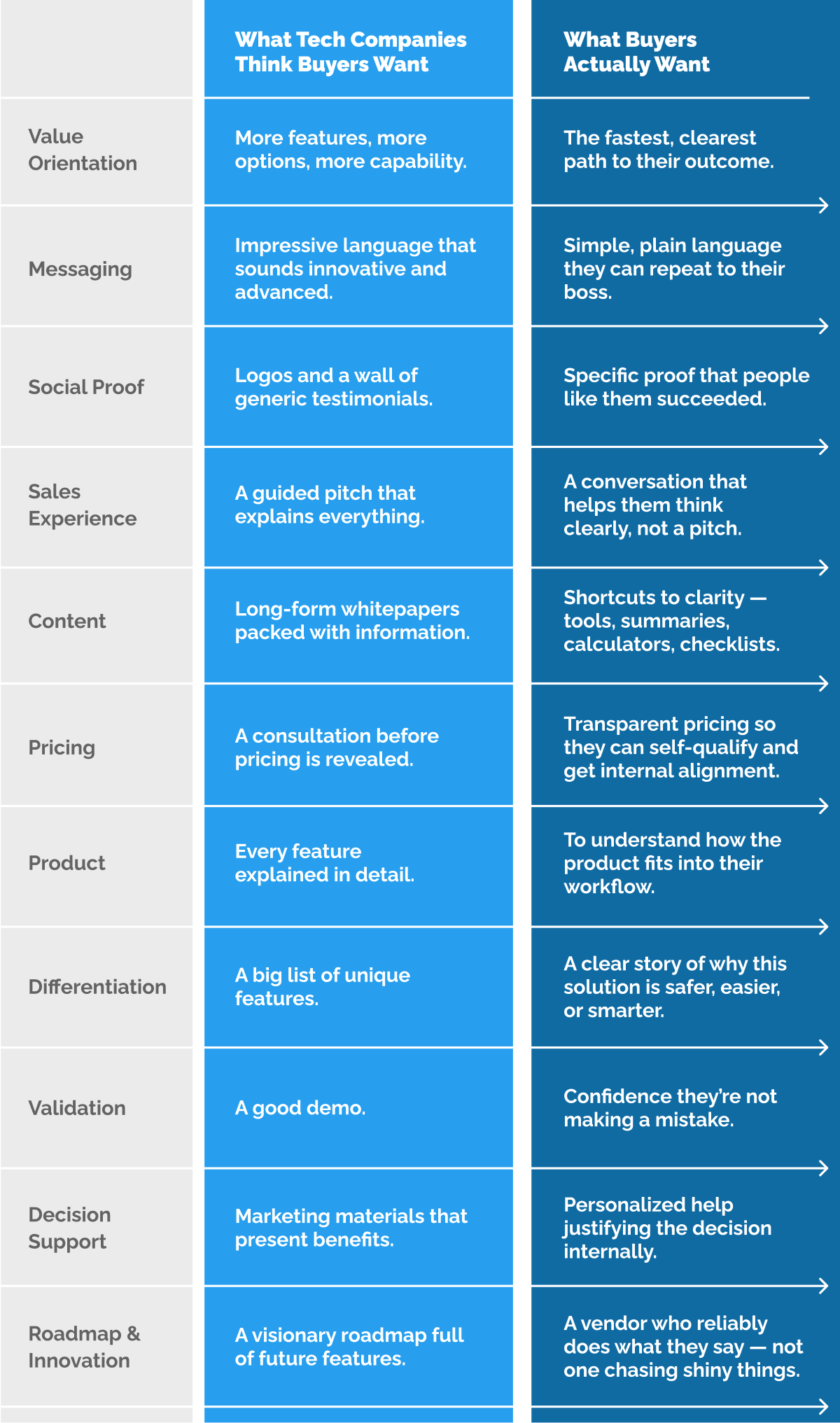
A buyer-centric mindset is how you’ll win.
Key Data Points
61% of B2B buyers prefer a rep-free buying experience.
Shows buyers now expect to research and self-serve — reinforcing that your marketing must speak to them directly, not via sales archetypes.
Before contacting a vendor, B2B buyers consume an average of 11 pieces of content.
Demonstrates that buyers are well informed before they talk to sales — so messaging + positioning must be strong up front.
Between 57%–70% of the buying research journey is completed before a buyer ever reaches out to sales.
Reinforces that the majority of the buyer’s decision-making happens “in the dark” — exactly why deeply understanding buyers matters.
Create a Multi-Layered Content System for a Zero-Click, AI-Ranked World
I remember when marketing really was simpler.
Write a blog. Post it on LinkedIn. Hope Google tosses you a few impressions like bread crumbs. Those days seem gone.
Now content has become a whole different game — faster, noisier, and ruled by an entirely new gatekeeper:
AI.
Buyers aren’t starting with search engines anymore.
They’re starting with:
- ChatGPT
- Perplexity
- Claude
- Gemini
- And every AI built into the tools they already use
I’ve spent much of the last year studying this shift firsthand. The reality is that Search optimization is dying for one simple reason: human psychology. I wrote about it here.
Which means your content isn’t competing with “other companies.”
It’s competing with the single best answer the internet can generate.
And if your content isn’t answer-worthy, structured-enough, or value-dense enough?
AI simply… doesn’t choose you.
The Era of Zero-Click Discovery
Google has been flirting with zero-click for years, but now it’s fully embraced it — and AI engines make it even more extreme.
Here’s the part most tech companies haven’t caught up with:
Buyers are still consuming a ton of content — they’re just not clicking to do it.
AI tools read your content.
Analyze it.
Summarize it.
And then deliver the answer directly to the buyer.
Clicks cost more.
Attention lasts shorter.
Expectations are higher.
The implication is simple:
Your content must be built for both humans and AI models.
The Omniscient Buyer
By Andy Halko, CEO of Insivia
That’s why your content must anticipate a buyer who’s already halfway to a decision — and is simply looking for the clearest path forward.
A Modern Content System Has Layers
The top software and tech companies aren’t “blogging more.”
They’re building multi-layered content ecosystems designed to feed discovery, search, AI models, social networks, buying groups, and actual humans.
Here’s what that looks like:
Layer 1: Buyer-Language Content (the foundation)
This is content written in your buyer’s vocabulary — not your internal jargon. It’s:
- Problem-first
- Role-specific
- Pain-aware
- Emotionally intelligent
- Free of buzzword soup
This is the layer AI models love to pull from because it’s clear, structured, and human.
Layer 2: Authority Content (the differentiator)
This includes:
- “We’ve seen the pattern” insights
- Industry-specific points of view (for your EdTech, HRTech, LegalTech, etc. audiences)
- Strategic frameworks
- Playbooks
- Comparison content buyers use behind closed doors
This layer proves you’re not just another tool — you’re a guide.
Layer 3: Answer-Optimized Content (the AI magnet)
One thing I’ve learned: AI engines reward clarity, structure, and specificity. If your content is messy, AI simply ignores you.
This is content structured for extraction by:
- ChatGPT
- Perplexity
- Gemini/SGE
- Specialist AI agents
Think:
- Clear headers
- Short, strong definitions
- Step-by-step explanations
- Lists that can be reformatted into answers
- Pages designed for snippet + cite-ability
If you want AI to select your content, you have to make it easier to extract.
Layer 4: Conversion-Intent Content (the closer)
This content speaks to buyers who are already warm:
- Feature pages
- Walkthroughs
- “For X Industry” pages
- Buyer-enablement content
- Case studies (built as “proof assets,” not bedtime stories)
- Pricing breakdowns
- Objection handling pages
This is where buyers decide, “Okay, this is the one.”
Layer 5: Social & Distribution Content (the amplifier)
The best tech companies don’t just create content — they distribute it aggressively:
- Short-form expert clips
- Opinionated posts
- Visual explanations
- Insights mined from customer calls
- “Building in public” style storylines
Distribution makes the whole system actually work.
Content Has a New Job: Reduce Friction
In a world where buyers can get generic advice from any AI engine, your content has one mission:
Make your buyer’s life significantly easier than your competitor does.
That might mean:
- Mapping their buying process
- Clarifying the unseen risks
- Explaining what vendors never say out loud
- Translating complicated decisions
- Outlining the path from problem → solution → justification
If your content helps someone think more clearly, AI will reward you.
Humans will reward you.
And your sales team will send you thank-you messages that feel suspiciously emotional.

What About SEO?
SEO still matters — just not the way it used to.
Search engines may still drive buyers, but even they are leaning towards delivering answers instead of link lists.
2026 SEO is:
- Structured data
- Consistency for Algorithmic matching
- Niche topical authority
- Content velocity ( the right kind )
- Intent alignment
- Schema
- Experience signals
- AI training signals
- And extremely high-quality content
Bottom Line: Create Content That’s Easy to Learn From, Easy to Extract, and Impossible to Ignore
If you write content that:
- Uses the buyer’s language
- Answers real questions deeply
- Provides value AI wants to cite
- Offers clarity no competitor does
- Doesn’t insult the reader’s intelligence
- Helps shorten the internal decision-making process
…you win in every channel.
Because the companies thriving today aren’t the ones producing more content.
They’re the ones producing the kind of content buyers actually trust.
Key Data Points
89% of B2B buyers say they’ve adopted GenAI as a tool for self-guided research at some point.
Indicates that AI isn’t fringe — it’s mainstream among business buyers doing research.
48% of B2B buyers report using generative-AI (GenAI) tools for vendor discovery — and a sizable portion use AI for vendor vetting / shortlisting.
This shows that nearly half of potential buyers now begin their vendor search with AI, not Google or direct company sites — underlining the shift to AI-first discovery.
More than half of B2B buyers in a 2025 survey say they expect to increase their use of AI for tasks like market research, vendor evaluation, and supplier shortlisting in the next 12 months.
Suggests that AI use in the buyer journey is still accelerating — it’s not a fad.
Leverage Interactive Experiences to Drive Engagement & Conversion
At some point over the last decade, tech companies convinced themselves that buyers want to “read more content.”
Whitepapers. PDFs. Bulky paragraphs of minutiae.
The honest truth is I don’t read long PDFs and will never enter my information for one. I don’t suspect too many people do anymore.
Instead people want:
Clarity.
Speed.
Personal relevance.
Proof.
Action.
And nothing delivers those faster than interactive content and experiences.
Interactive experiences transform your marketing from a monologue into a conversation. They give buyers a way to explore, evaluate, calculate, compare, diagnose, and self-educate without having to schedule a demo, download a PDF, or mentally assemble your pitch themselves.
In 2026 and beyond, interactive experiences aren’t “nice to have.”
They’re the backbone of high-intent conversion.
Why Interactivity Works So Well for Tech Buyers
Technology buyers — whether in EdTech, HRTech, LegalTech, consulting, MarTech, or any flavor of SaaS — are naturally analytical. They want to see how something works. They want to test assumptions, estimate impact, explore options, and validate that your solution fits their very specific world.
Interactive tools create:
- Understanding (buyers comprehend value faster)
- Trust (you’re transparent and confident enough to show the math)
- Commitment (when someone inputs data, they’re emotionally invested)
- Shorter sales cycles (buyers enter conversations already informed)
- Higher conversions (because buyers get personal relevance instantly)
It’s where Buyer Psychology meets Demand Generation.
Types of Interactive Experiences That Actually Move the Needle
Not every interactive thing is worth building. (Looking at you, “spin the wheel” coupon popups.)
But these are the formats consistently producing results for tech and software companies:
1. ROI Calculators & Business-Case Builders
Where buyers plug in their numbers and instantly see whether you’re worth the spend—or not.
Tech buyers love numbers.
Finance loves numbers even more.
A good calculator removes friction from one of the hardest parts of the buying journey: justifying the cost.
Great for: SaaS, automation platforms, analytics tools, cybersecurity, workflow software.
2. Product Configurators & Recommendation Engines
Guides buyers to the exact plan or setup they need, without the “it depends…” dance.
Buyers often don’t know exactly what they need. A configurator guides them based on:
- goals
- use cases
- team size
- industry
- maturity level
It’s like having a pre-sales engineer packaged into a 30-second experience.
3. Assessment Tools & Diagnostic Graders
A quick “reality check” that shows buyers the gap between where they are and where they wish they were.
These allow buyers to evaluate:
- their current process
- their gaps
- their compliance posture
- their operational maturity
- their risk level
These tools position you as a trusted advisor — not just a vendor.
4. Interactive Demos & Guided Product Tours
The closest thing to “just let me try the damn thing” without requiring an account.
Let buyers click around.
Let them see features.
Let them experience the value.
No email gates. No hoops. Just transparency and confidence.
5. AI Assistants, On-Site Chat Experiences & “Ask Me Anything” Widgets
A smarter, nicer version of your sales engineer—available 24/7 and without the scheduling back-and-forth.
These go way beyond chatbots.
Modern AI experiences help buyers:
- compare vendors
- summarize features
- review pricing
- generate custom onboarding plans
- ask technical questions
- explore docs in natural language
This is “software sales enablement,” but delivered instantly by AI.
6. Visual Explainers, Simulators & Sandbox Environments
Make abstract value concrete: let buyers see workflows, automations, or results instead of imagining them.
These help buyers understand:
- how workflows change
- what automation actually does
- how integrations behave
- what the new process will look like
It makes abstract value tangible.
Interactive Content Is a Secret Weapon for Zero-Click Environments
When buyers do most of their research inside ChatGPT, Perplexity, SGE, and other AI tools, you need a strategy to earn the click only when buyers have intent.
Interactive tools are that strategy.

AI engines summarize content, but they can’t replicate personalized experiences.
A buyer may get the basics from AI, but they come to you to get answers calibrated to:
- their industry
- their role
- their team
- their current system
- their goals
- their pain level
Interactivity creates a reason to visit your site.
And Here’s the Magic: Interactive Tools Produce Buyer Data You Can’t Get Anywhere Else
Some of the most valuable buyer insights I’ve ever uncovered came from interactive tools — not surveys, not interviews, not analytics dashboards.
I remember years ago reading about how looking at Google Search trends was way more accurate than a survey because people lie in surveys but ask their truth in search bars.
Interactive tools are similar and every interaction becomes a data point:
- what role the buyer has
- what problem matters most
- where they’re stuck
- what they compare
- what they estimate
- what they value in ROI
- what they can’t justify internally
This data becomes fuel for:
- your content strategy
- your AEO targeting
- your email nurture
- your sales conversations
- your product roadmap
- your positioning
- your ICP refinement
You’re not just engaging buyers — you’re learning from them.
Ultimately, Interactive Experiences Do What Great Content Used to Do (But Better)
- They educate.
- They differentiate.
- They persuade.
- They reduce friction.
- They guide the buyer.
- They build trust faster.
And they convert high-intent traffic far more effectively than static content.
Because the companies winning aren’t the ones shouting the loudest…
They’re the ones helping buyers make sense of their world the fastest.
Key Data Points
Interactive content generates ~2× more conversions than static content.
Demonstrates interactive assets (calculators, assessments, etc.) perform significantly better than traditional content.
Gated calculators & interactive tools convert at 25–45%, compared with 9–14% for static PDFs.
Shows that even simple interactive tools dramatically increase lead capture vs. old-school PDF/whitepaper gating.
58% of users will submit their email to access personalized results from interactive tools.
Confirms strong lead-capture potential — interactive tools motivate users to exchange real info for value.
Use AI to Scale Content, Research & Execution
If the last decade was about “creating more ( content, demos, automations, personalization ),” the next decade is about something far more strategic:
Creating smarter — at a pace humans alone can’t keep up with.
AI isn’t replacing marketing teams.
But it is replacing every repetitive, mechanical, low-value task that used to swallow your team’s time and energy.
And in the next 5 years, the tech and software companies scaling the fastest aren’t the ones who adopted AI the earliest — they’re the ones who learned how to integrate it thoughtfully, strategically, and consistently.
They don’t use AI to generate noise.
They use AI to multiply clarity.
AI Isn’t a Shortcut — It’s a Force Multiplier
The companies doing this well understand a simple truth:
Humans are best at judgment.
AI is best at processing.
Pair them, and you get velocity with accuracy.
This combination lets marketing teams:
- Ship better content in less time
- Analyze markets more deeply
- Understand buyers more accurately
- Experiment more aggressively
- Personalize without burnout
- Maintain consistency at scale
AI doesn’t replace expertise.
It amplifies it.
Where AI Makes the Biggest Impact in Modern Marketing
Not all AI use is created equal.
Writing 200 robotic blog posts? Not the move.
Here’s where AI produces actual results for SaaS / tech companies:
1. Insight Mining & Research Automation
AI combs through calls, comments, forums, and competitors so you stop guessing and actually know what buyers care about.
Buyers are complicated.
Markets shift.
Competitors change messaging every six minutes.
AI helps you:
- Analyze customer calls
- Monitor industry conversations
- Evaluate competitor content
- Summarize long buying-committee discussions
- Detect emerging themes
- Surface objections and repeated phrases
- Understand how different segments think
It gives you an unfair advantage: faster, clearer understanding.
2. Content Acceleration Without Losing Voice
You keep the strategy and tone; AI handles the heavy lifting so content stops taking three weeks and five people.
AI helps with:
- Brainstorming & Drafting
- Rewriting & Repurposing
- Turning webinars into articles
- Turning articles into scripts
- Turning scripts into social posts
Really the sky is the limit when it comes to the ability to take a more accurate, valuable piece of content and reimagine it in different forms.
The key is simple:
The strategy stays human.
The production becomes hybrid.
This gives you quality at speed — not volume for volume’s sake.
3. Message Testing at Uncomfortable Speed
Instant clarity checks on what resonates—without burning budget on real traffic or waiting for A/B test luck.
You can use AI to:
- Test 20 variations of a headline
- Compare positioning statements
- Run sentiment analysis
- Evaluate clarity
- Review reading complexity
- Check industry relevance
- Predict objections
It’s essentially A/B testing without burning real traffic.
4. Personalization Without Complexity
AI tailors messaging, emails, and product guidance so every buyer feels like the experience was built for them.
Buyers expect personalization.
Humans can’t scale it.
AI can.
AI can tailor:
- Website messaging
- Email sequences
- Product recommendations
- Onboarding flows
- In-product guides
- Case study selections
- Pricing explanations
Everyone gets a better experience.
Your team doesn’t drown.
5. Sales & Customer Success Enablement
AI becomes your team’s behind-the-scenes assistant—drafting follow-ups, summarizing calls, and prepping insights on demand.
Sales teams can use AI to:
- Instantly craft personalized follow-ups
- Translate buyer pains into value statements
- Review long email threads
- Prepare for calls
- Write recap notes
- Clarify technical answers
- Research accounts
This isn’t “chatbot territory.”
It’s human-assisted intelligence, and it dramatically shortens cycles.
6. Operational Efficiency Across Marketing
The unsexy but powerful stuff—tagging, documenting, auditing, organizing—finally gets done without eating your week.
AI helps teams:
- Build briefs
- Organize campaigns
- Tag content
- Audit site pages
- Identify SEO/AEO gaps
- Maintain knowledge bases
- Document processes
It’s the glue that reduces operational drag.
AI + Humans = A New Creative Rhythm
The companies doing this well create workflows like:
Human decides → AI drafts → Human sharpens → AI formats → Human approves → AI distributes
This isn’t “cheating.”
It’s the future of craft.
Designers, writers, strategists, and product marketers get to operate at a higher strategic level — because AI takes the weight of the repetitive work.
Your Competitors Aren’t Just Using AI — They’re Scaling With It
Here’s the uncomfortable part:
Your competitors are not waiting.
AI is now a competitive advantage in:
- Speed
- Insight
- Relevance
- Buyer understanding
- Content authority
- Sales readiness
- Internal alignment
If you’re using humans alone, you’re competing against companies with a team that works 10× faster and never sleeps.
The Real Point: AI Isn’t Here to Replace Your Team. It’s Here to Replace Your Excuses.
AI is the biggest acceleration tool marketing teams have ever had.
But only if you treat it as a system — not a novelty.
The companies winning aren’t the ones who post “We use AI!” on their website.
They’re the ones whose marketing feels sharper, clearer, faster, more consistent, and more aligned with what buyers actually care about — because AI gives them the time and mental space to do it.
Develop a Hybrid PLG + SLG Growth Motion
For years, SaaS companies argued about whether Product-Led Growth (PLG) or Sales-Led Growth (SLG) was the “right” model — as if choosing one unlocked a secret cheat code.
2026 finally settled the debate:
The fastest-growing tech companies use both.
And the buyer decides which path they take.
Tech buyers across verticals don’t follow a neat, linear journey. They bounce between product exploration, team conversations, online research, AI guidance, and sales interactions depending on:
- urgency
- risk level
- team size
- budget
- internal politics
- complexity
- personal preference
Trying to force every buyer into a single motion is the marketing equivalent of trying to teach a cat to heel.
Buyers choose their own adventure.
Your job is to support every path.
Why Hybrid GTM Works in 2026
PLG works because buyers want autonomy.
SLG works because organizations have complexity.
A hybrid GTM system works because it:
- Respects the buyer’s preferred research style
- Supports high-velocity deals and complex enterprise ones
- Aligns with how modern teams evaluate software
- Reduces friction in onboarding and expansion
- Creates more entry points into the funnel
- Lowers acquisition costs without sacrificing ACV
- Generates revenue through multiple channels instead of one
It’s not “PLG vs. SLG.”
It’s “PLG where possible, SLG where valuable.”
The Four Buyer Paths in a Hybrid GTM System
There are four main routes buyers take — your system should support all of them:
1. Self-Serve → Purchase (Pure PLG)
For buyers who want zero friction and zero talking—just value and a credit card field.
Buyers want:
- immediate access
- quick validation
- zero friction
- zero commitment
They sign up, they explore, they swipe the corporate card.
Great for: tools with low risk, clear value, and intuitive UX.
2. Self-Serve → Talk to Sales (Product-Assisted Sales)
Buyers explore on their own, then show up to sales with specific questions and actual intent.
Buyers want to:
- explore on their own
- then confirm with a human
- ask advanced or strategic questions
- understand integrations or compliance
This is one of today’s most common paths — and one of the easiest to ignore if your motions aren’t aligned.
3. Sales → Guided Demo (Traditional SLG)
For complex, political, or enterprise deals where buyers need a human to build confidence and alignment.
Buyers want:
- a custom walkthrough
- a business case
- multi-person evaluation
- internal alignment
- procurement friendliness
- security review
Enterprise? Regulated industry? Complex workflows? This is the path.
4. AI-Guided → Product or Sales (The Emerging Path)
Buyers ask AI who to shortlist—and your GTM needs to be ready for whichever route AI points them to.
Increasingly common, especially among tech-savvy buyers.
Buyers ask an AI tool:
- “Which vendor fits X use case?”
- “Compare X vs. Y.”
- “Create my shortlist.”
Then they either jump straight into a trial or book a demo.
Your GTM needs to be ready for both.
Marketing’s Role in Hybrid GTM (Hint: It Just Became Much Bigger)
In a hybrid model, marketing isn’t just top-of-funnel.
Marketing becomes the architect of the entire buyer experience.
Your team is responsible for:
- Tailoring messaging to each path
- Ensuring the website supports both self-serve and sales-led flows
- Creating interactive tools for PLG
- Creating trust assets for SLG
- Positioning the product clearly for both motions
- Unifying the buyer journey across product, web, and sales touchpoints
- Feeding each path with personalized nurture and education
- Supporting long-term expansion
Hybrid GTM is basically “buyer-centricity at the motion level.”
Why So Many Tech Companies Fail at Hybrid GTM
The common mistakes:
- PLG and SLG teams operate separately
- Messaging isn’t aligned between product and sales
- Free trial experiences feel disconnected from demos
- Sales doesn’t understand in-product signals
- Product teams don’t understand buyer psychology
- Growth teams optimize for the wrong stage
- Pricing doesn’t match the actual buyer journey
- Data between tools is fragmented
Hybrid requires orchestration — not chaos with a nice diagram.
Signals You Need a Hybrid Motion (Most Tech Companies Do)
If you see any of these, hybrid GTM is your new best friend:
- Free trials get signups but not conversions
- Sales cycles drag on too long
- Buyers keep asking sales questions that the site doesn’t answer
- Your highest-intent buyers still want a demo
- Expansion relies on human intervention
- Procurement derails deals late in the process
- Buyers try the product but don’t understand the value
- You have multiple buyer personas, each with different needs
Hybrid is the only model flexible enough to support multiple personas, multiple use cases, multiple buying styles, and multiple deal sizes.
This Is the Real Point: Let the Buyer Lead the Way
Some buyers want to explore.
Some want to verify.
Some want a conversation.
Some want to be handheld.
Some want to skip everything and throw money at the problem.
Some want AI to walk them through the decision.
A modern GTM motion doesn’t push buyers into a path — it follows them.
The companies winning don’t force a choice.
They simply make every choice brilliant.
Implement a Conversion-Obsessed Website Strategy
There was a time when a technology company’s website was basically an online brochure:
a hero headline, a features list, a contact form, maybe a blog that hadn’t been updated since that one intern left.
But in 2026 and beyond?
Your website is no longer a marketing asset.
It’s your primary revenue engine.
It’s your salesperson.
Your educator.
Your product tour.
Your validation layer.
Your differentiation.
Your first impression.
Your last impression.
Your highest-intent touchpoint.
Your most measurable channel.
And the place where buyers decide whether to move forward — or move on.
A modern tech website isn’t “designed.”
It’s continuously engineered around one simple obsession:
Every interaction should increase clarity, confidence, and conversion.
Why Your Website Matters More Than Ever
Tech buyers show up later in their journey.
They’ve done the anonymous research.
They’ve consulted internal stakeholders.
They’ve asked AI for comparisons.
They’ve read reviews.
They’ve browsed your competitors.
By the time they land on your site, they’re not casually browsing.
They’re evaluating.
They’re deciding.
They’re trying to answer, “Is this worth my time, my team’s time, and my political capital?”
Your website must do heavy lifting — fast.
The Conversion-Obsessed Website Has Four Jobs
A high-performing website must serve four critical functions:
1. Clarify the Buyer’s World, Not Your Product
Your site’s job is to make the buyer’s world make sense—your product is just a piece of that puzzle.
Most tech companies talk about:
- features
- architecture
- integrations
- modules
Your buyer is trying to:
- solve a problem
- justify a purchase
- evaluate risk
- understand ROI
- compare options
- align stakeholders
Your website should make their world feel clearer, not your product feel bigger.
This means:
- problem-based messaging
- buyer-specific value props
- personalized paths
- scenario examples
- industry-centric positioning
- clear answers to “why now?”
If your homepage sounds like “We help companies optimize mission-critical outcomes through end-to-end intelligent orchestration”
… you’re doing the opposite.
2. Deliver a Guided, Intuitive Journey (With Zero Guesswork)
Give buyers a clear path forward so they never wonder “where do I go now?” or “what does this actually do?”
Your buyer should never wonder:
- “Where do I go next?”
- “Am I in the right place?”
- “How do I understand what this actually does?”
Every page should lead to the next logical step:
- use cases → solutions
- solutions → features
- features → product tours
- tours → ROI tools
- tools → pricing
- pricing → CTA
Think of your site as a GPS:
Buyers choose the destination — you eliminate the detours.
3. Provide Transparent Proof and Remove Risk
Show real evidence quickly, because buyers assume you’re hiding something if you don’t.
In tech buying, trust collapses easily.
Buyers are skeptical and overloaded with choices.
Your site must quickly answer:
- “Does this actually work?”
- “Who else uses it?”
- “Where’s the proof?”
- “How much will this cost me?”
- “What could go wrong?”
Proof assets include:
- case studies (short, sharp, and buyer-focused)
- screenshots (real, not mocked into fantasy)
- product videos
- ROI calculators
- third-party reviews
- comparison pages
- customer logos
If your site hides critical information, buyers assume it’s bad news.
4. Make High-Intent Conversion Effortless
When someone is ready, don’t make them hunt for the next step—make it stupidly easy.
The biggest mistake tech companies make is treating CTAs like decoration.
If someone lands on:
- your pricing page
- your product page
- your solution page
…they’re not “browsing.”
They’re testing you.
Conversion should feel:
- clear
- simple
- zero-risk
- contextual
- valuable
This means:
- frictionless demo booking
- “instant access” or “try now” options
- calendar integrations
- low-touch micro CTAs (e.g., save a pricing estimate, share with team)
- AI-guided evaluation flows
- interactive tools that warm buyers before sales ever meets them
High-intent clicks are rare. Treat them like gold.
The Real Differentiator: Continuous Optimization, Not “Launch and Leave”
Most companies redesign their site every 3–5 years.
That’s the digital equivalent of ignoring your product roadmap until it breaks.
The companies winning in 2026 run websites like software:
- monthly (or weekly) iterations
- real user behavior analysis
- A/B testing
- clarity optimization
- content refreshes
- new proof assets
- UX updates
- funnel experiments
- AI-assisted personalization
- interactive experience deployment
Your site becomes a compounding asset — not a one-off project.
You don’t “launch a website” anymore.
You run it.
The Modern Tech Website Is Built for People Who Already Know a Lot — and Still Need Answers
By the time buyers reach your site, they’ve already:
- formed opinions
- tested assumptions
- shortlisted vendors
- asked an AI for comparisons
- read review sites
- tried your freemium or competitor’s
Your job isn’t to overwhelm them with information.
Your job is to help them make the best decision — and make it easy to choose you.
The companies dominating 2026 treat their website like a living, breathing growth engine.
The ones still treating it like a digital brochure?
They get left behind — quietly, and fast.
Build a Unified Revenue Engine Powered by Buyer Data
If there’s one thing technology companies are great at, it’s collecting data.
If there’s one thing they’re terrible at, it’s using it.
Dashboards everywhere.
Attribution models arguing with each other.
Sales has one version of the truth.
Marketing has another.
Product has a third one nobody’s looked at in six months.
Meanwhile, your buyer is moving through a journey that spans all three departments — and none of your systems talk to each other well enough to stay in sync.
Top-performing software and tech companies have all reached the same conclusion:
Revenue isn’t generated by departments.
Revenue is generated by alignment.
And that alignment comes from building a unified revenue engine — one powered by actual buyer data, not guesses, silos, or political turf wars.
What a Unified Revenue Engine Actually Means
It’s not a tech stack.
It’s not a dashboard.
It’s not a reorg that everyone resists and then forgets.
A unified revenue engine is a system where:
- marketing, sales, product, and customer success operate from the same buyer understanding
- buyer data flows across every stage of the journey
- teams collaborate instead of competing
- messaging stays consistent
- KPIs reinforce each other
- decisions are made with clarity, not assumptions
Every part of the organization becomes responsible for one thing:
Helping the buyer progress with confidence.
Why This Matters So Much in Tech & Software
Software buyers don’t make decisions in isolation.
They move through a sequence of micro-moments:
- discovering a problem
- comparing vendors
- reading content
- testing the product
- evaluating integrations
- consulting peers
- running ROI math
- talking to finance
- negotiating procurement
- onboarding
- expanding
Every moment creates a data trail.
Every moment can strengthen or weaken trust.
A unified revenue engine captures these moments, interprets them, and turns them into action.
The Six Components of a High-Performing Unified Revenue Engine
1. A Shared, Buyer-Centric Understanding of Your Audience
Every team finally stops using their own version of your ICP and persona—and operates from one shared truth.
No more sales using one persona, marketing using another, and product using whatever was written during the last redesign.
Everyone uses:
- the same ICP
- the same persona detail
- the same pain matrix
- the same buying triggers
- the same job-to-be-done logic
- the same language map
This ensures every touchpoint reinforces the same buyer worldview.
2. Clean Data That Flows Across Systems
Your stack should feel like one system, not a haunted house of integrations.
This means:
- unified CRM
- MAP + product analytics sync
- lifecycle stages that actually reflect reality
- AI-assisted tagging
- behavior-based scoring
- centralized attribution
- unified reporting
When teams share the same data, they share the same truth.
3. Intent Signals That Trigger Real Actions
Intent signals are gold.
Every click, return visit, or behavior becomes fuel for smarter, faster buyer support.
Signals tell you:
- what the buyer read
- what tools they used
- what pages they returned to
- what features they trialed
- what objections they searched
- what problem they’re trying to solve
- where they are in their internal process
A unified engine routes these signals automatically:
- to nurture
- to sales
- to product onboarding
- to customer success
Buyers feel supported.
Teams act proactively.
4. Multi-Touch Attribution Built for Real Buyer Journeys
Because buyers don’t follow linear funnels anymore—and your attribution shouldn’t pretend they do.
Tech buyers are messy.
Their journeys aren’t linear.
Attribution models built for 2016 don’t cut it.
A modern engine uses:
- blended attribution
- journey analytics
- account-level tracking
- AI-assisted path mapping
- influence scoring
- time-to-value insights
The point isn’t to find “the winner.”
The point is to understand the ecosystem that created momentum.
5. Connected Enablement Across Marketing, Sales, and Customer Success
Marketing creates the story; sales personalizes it; CS reinforces it—and everyone finally rows in the same direction.
Great enablement isn’t a sales portal.
It’s a system.
Marketing produces:
- clarity assets
- case stories
- competitor breakdowns
- objection handling guides
- ROI tools
Sales turns them into:
- personalized narratives
- stakeholder arguments
- proof of fit
CS uses them to:
- reinforce value
- support adoption
- drive expansion
Everyone wins because everyone is using the same buyer playbook.
6. Shared KPIs That Align Behavior
When all teams measure success the same way, they stop working against each other by accident.
Silos create misaligned incentives.
Misaligned incentives create bad decisions.
A unified revenue engine aligns teams around metrics that matter:
- revenue
- retention
- expansion
- velocity
- activation
- product adoption
- customer health
When teams win together, they stop optimizing against each other.
The Highest-Growth Tech Companies All Share One Pattern
They don’t treat marketing, sales, product, and customer success as separate teams.
They treat them as:
- one buyer experience
- one revenue system
- one story told consistently
- one engine constantly learning from data
Because buyers don’t experience your company in pieces.
They experience it as a whole.
When you remove silos, unify data, and build a shared understanding of the buyer…
Everything feels easier — and everything performs better.
The companies scaling the fastest in 2026 aren’t the ones with the flashiest tactics.
They’re the ones with the clearest understanding of their buyer
— and a revenue system aligned to serve them.
The Must-Do & Shouldn’t-Do Playbook for the Next Era of Tech Marketing
The next few years will reshape how technology companies grow.
AI is rewriting discovery.
Buyers are rewriting expectations.
And the companies that win won’t be the ones shouting the loudest — they’ll be the ones aligning the deepest.
Here’s your clear, no-nonsense guide for what to do (and what not to do) between now and 2030.
Must Do: What Technology Companies Need to Lean Into
- Build your marketing around actual buyers — not your product architecture.
Stop assuming. Start observing. Understand how real buyers think, speak, decide, fear, justify, and evaluate. - Architect an AI-first content ecosystem.
If AI engines can’t extract your content, summarize it, or trust it, buyers will never see it. - Invest heavily in interactive experiences.
ROI tools, configurators, graders, tours, AI assistants — these are the new “high intent” assets. - Treat your website like a software product — with continuous updates.
Quarterly web releases. Constant testing. Fresh messaging. Zero dust. - Build a hybrid PLG + SLG journey and let buyers choose their path.
They want autonomy AND expertise. Give them both. - Embrace AI as the backbone of research, analysis, and production.
Not for volume. For velocity, clarity, and intelligence. - Capture and operationalize buyer data across marketing, sales, product, and CS.
Every signal matters. Every team should see it. Every system should use it. - Publish content that has a point of view — not just a pulse.
In crowded tech markets, neutrality is invisibility. - Design all messaging around clarity, not complexity.
Complexity isn’t a sign of sophistication. It’s a sign of insecure positioning. - Build proof libraries, not one-off case studies.
Buyers want validation, not testimonials. Show the outcomes, not the compliments.
Shouldn’t Do: What Tech Companies Need to Stop Immediately
- Don’t over-rely on SEO like it’s still 2018.
SEO matters — but AEO and AI-ranked content matter more. - Don’t gate generic PDFs or whitepapers and call it “lead generation.”
Nobody wants to exchange personal info for content that could’ve been an AI summary. - Don’t force every buyer into a demo or every buyer into self-serve.
Rigid funnels are conversion killers. - Don’t publish content that sounds like it was written by your internal committee.
Buyers can smell jargon from five screens away. - Don’t ignore the free trial or product experience.
If it’s confusing or under-explained, no amount of marketing saves it. - Don’t treat your website as a set-and-forget project.
If your site only evolves during redesign years, you’re bleeding revenue. - Don’t silo marketing, sales, product, and CS data.
Silos don’t just slow you down — they break the buyer experience. - Don’t hide pricing, product details, or validation assets.
Transparency isn’t risky. Lack of transparency is. - Don’t create content that tries to sound smart instead of being useful.
Your buyer’s job is already hard. Don’t make their research harder. - Don’t pretend AI isn’t reshaping your category.
Buyers are using AI. Competitors are using AI. You should too.
My Final Word
The next few years in tech marketing won’t reward the loudest voices — they’ll reward the clearest ones. The most empathetic ones. The ones aligned tightly to the way real buyers think, decide, and navigate increasingly complex decisions.
If you build systems around your buyer, adapt quickly to AI-driven change, and treat your marketing engines like living products, you’ll be ahead of 95% of the industry.
The future of tech marketing is buyer-centric, AI-aligned, and clarity-obsessed.
Build around that, and the next decade becomes a lot more exciting.

Written by: Andy Halko, CEO, Creator of BuyerTwin, and Author of Buyer-Centric Operating System and The Omniscient Buyer
For 22+ years, I’ve driven a single truth into every founder and team I work with: no company grows without an intimate, almost obsessive understanding of its buyer.
My work centers on the psychology behind decisions—what buyers trust, fear, believe, and ignore. I teach organizations to abandon internal bias, step into the buyer’s world, and build everything from that perspective outward.
I write, speak, and build tools like BuyerTwin to help companies hardwire buyer understanding into their daily operations—because the greatest competitive advantage isn’t product, brand, or funding. It’s how deeply you understand the humans you serve.