How EdTech Buyers Actually Make Decisions
Education buying is a system of risk management, not a process of value comparison.
Most EdTech teams believe they lose deals because buyers don’t fully understand the value. That belief is wrong—and it’s expensive. EdTech buyers don’t fail to buy because they’re unconvinced. They hesitate because they’re exposed.
In education markets, decisions are not made to maximize upside. They’re made to minimize downside. This pillar introduces a core mental model:
EdTech buying is a defensive system designed to avoid regret, scrutiny, and blame—long after the purchase is made.
Once you understand this system, buyer behavior that feels irrational suddenly becomes predictable.
The Decision System Education Buyers Operate Within
Education buyers don’t ask, “Is this the best solution?”
They ask, often subconsciously:
- Will this decision create risk for me personally or professionally?
- Can I defend this choice internally if something goes wrong?
- Has someone like us made this decision before—and survived it?
These questions shape every stage of evaluation.
The Three Forces Governing EdTech Decisions
1. Risk Aversion Is Structural, Not Cultural Education buyers are not just accountable to boards, parents, taxpayers, faculty, regulators; they are controlled by long budget cycles and public scrutiny as well as institutional memory that outlives leadership tenures. Risk is not abstract. It’s personal and persistent.
2. Proof Is About Defense, Not Persuasion Buyers aren’t looking for reasons to believe you. They’re collecting evidence to justify themselves. Proof answers the question: “Can I defend this decision when I’m not in the room?”
3. Process Exists to Absorb Anxiety Committees, pilots, procurement steps, and reviews aren’t inefficiencies. They are psychological safety mechanisms. They slow decisions down so responsibility can be shared. This is the system your buyers are operating inside – whether they articulate it or not.
Why This System Breaks Most EdTech GTM Strategies
Most EdTech marketing and sales approaches assume:
- Faster decisions are better decisions
- ROI drives consensus
- Innovation is inherently attractive
Inside education institutions, these assumptions collapse.
When vendors push urgency, buyers feel pressure—not momentum. When vendors push innovation, buyers feel risk—not excitement. When vendors push ROI, buyers ask who will be blamed if it fails.
Until your strategy aligns with this decision system, friction is inevitable.
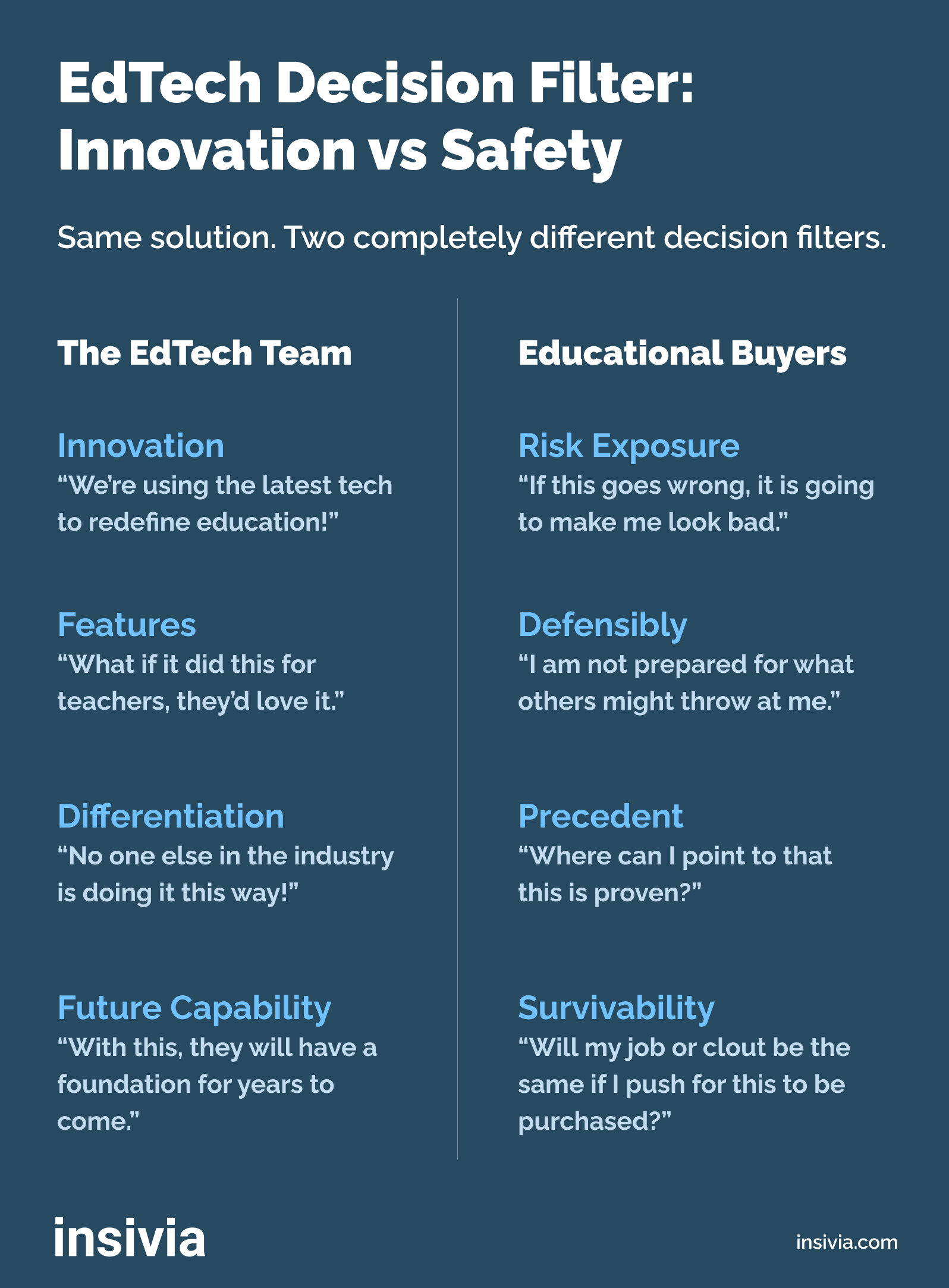
What EdTech Teams Must Internalize
Once you accept this decision system, several truths become unavoidable:
- Buyers are not irrational—they’re protective
- Delays are signals, not dysfunction
- Objections are often self-preservation mechanisms
The goal is not to push buyers through this system. The goal is to design around it.
FAQ
- Are EdTech buyers really more risk-averse than other B2B buyers?
-
Yes, but not because they’re conservative by nature. They operate in environments where:
- Failure is public
- Reversal is slow
- Consequences extend beyond revenue
Risk tolerance is shaped by accountability, not personality.
- Why doesn’t strong ROI accelerate decisions in education?
-
Because ROI does not neutralize blame. A decision can be financially sound and still career-threatening. Buyers need safety and upside—but safety comes first.
- Is this mindset different in K–12 vs Higher Education?
-
The system is the same. The pressure sources differ.
- K–12 buyers face public scrutiny and political oversight
- Higher Ed buyers face faculty resistance and decentralized authority
In both cases, defensibility outweighs performance.
- Why do buyers seem enthusiastic early, then go quiet?
-
Because early conversations are exploratory. As decisions move closer to reality:
- Risk becomes tangible
- Internal conversations intensify
- Silence often reflects internal alignment work—not disinterest
Quiet rarely means gone.
- Is procurement in EdTech really that influential?
-
Procurement is where anxiety peaks. It’s the moment where:
- Decisions become official
- Accountability crystallizes
- Exceptions become liabilities
Ignoring procurement psychology is one of the fastest ways to lose late-stage deals.
- Can vendors change this system?
-
No—and trying to fight it backfires. But vendors can:
- Reduce perceived risk
- Supply defensible proof
- Support internal justification
The winners don’t change buyer psychology. They align with it.
- What happens when EdTech teams ignore this reality?
-
They:
- Misread intent
- Push urgency at the wrong time
- Over-invest in features and under-invest in proof
Most stalled pipelines are not execution failures. They’re perspective failures.